Deciding to install solar panels is a fantastic financial choice. However, the most critical decision you must make next is choosing the right system type: Grid-Tie or Hybrid. Choosing wrong can mean wasting money on tech you don't need, or getting stuck in the dark during a typhoon.
Let's break down the mechanics, installation costs, utility regulations, and geographic suitability of both setups to help you make an informed decision for your home in Bulacan, Rizal, Cavite, Laguna, or Metro Manila.
| Feature | Grid-Tie Solar | Hybrid Solar |
|---|---|---|
| Starting Price (3kW) | ₱125,000 | ₱225,000 (includes LiFePO4 battery) |
| Battery Included? | No | Yes (Modular LiFePO4 battery) |
| Works in Brownouts? | No (Shuts down for safety) | Yes (Instant backup power) |
| Exporting Excess Power | Requires Net Metering (or Limiter) | Stores excess locally first |
| Ideal Location | Areas with stable utility grids | Blackout-prone provinces |
1. Grid-Tie Solar: The High-Efficiency Daylight Offset
A Grid-Tie system is the simplest and most common form of solar energy. It consists of solar panels connected directly to a grid-tied inverter. There are no battery storage devices in this configuration.
How it works: During daylight hours, your solar panels generate electricity to feed your home's active appliances (refrigerator, television, electric fans, and especially air conditioners). If your solar panels generate more than your home is consuming, the excess energy can be sent to the utility grid (if enrolled in Net Metering) or throttled using a smart limiter. At night, your home automatically pulls 100% of its power from the utility grid.
The Drawback: Because it is tied directly to the utility line, a grid-tied system must shut down during a power outage. This safety feature (called anti-islanding) prevents your panels from sending voltage through utility lines where technicians might be working.
Who it is best for: Homeowners in highly stable grid areas (like central business districts in Metro Manila) whose electricity consumption is predominantly during the day (e.g. running daytime aircon, home offices, or pool pumps).
2. Hybrid Solar: 24/7 Power Independence
A Hybrid system combines solar panels, a hybrid inverter, and a dedicated battery storage system (such as Lithium Iron Phosphate / LiFePO4 chemistry).
How it works: Like a grid-tie system, it powers your home during the day. However, instead of discarding or exporting excess daytime solar energy, a hybrid system uses it to charge your batteries. At night, the system runs your house off the stored battery power, bypassing the expensive retail electricity rates.
The Brownout Advantage: When the public grid goes down (due to line maintenance, rotating summer outages, or a severe typhoon), the hybrid inverter automatically detaches from the grid in milliseconds, switching your home to local battery backup. Your lights, fans, refrigerator, and router remain active.
Who it is best for: Families living in Bulacan, Rizal, Cavite, and Laguna, where provincial grids suffer from frequent line faults and storm disruptions. It is also ideal for families who work from home and cannot afford any internet or power interruptions.
Let's Talk Money: Cost and ROI Analysis
* Grid-Tie (starts @ ₱125,000): Because it has no batteries, a grid-tied system has a lower initial cost. The return on investment (ROI) is fast—often 2.5 to 4 years depending on daytime load shifting.
* Hybrid (starts @ ₱225,000): Adding a high-grade 100Ah LiFePO4 battery and a smart hybrid inverter increases the cost. However, the ROI remains highly competitive (4 to 6 years) because it allows you to offset the full retail electricity rate at night (saving ~₱12/kWh), rather than selling your power cheap to Meralco via net metering.
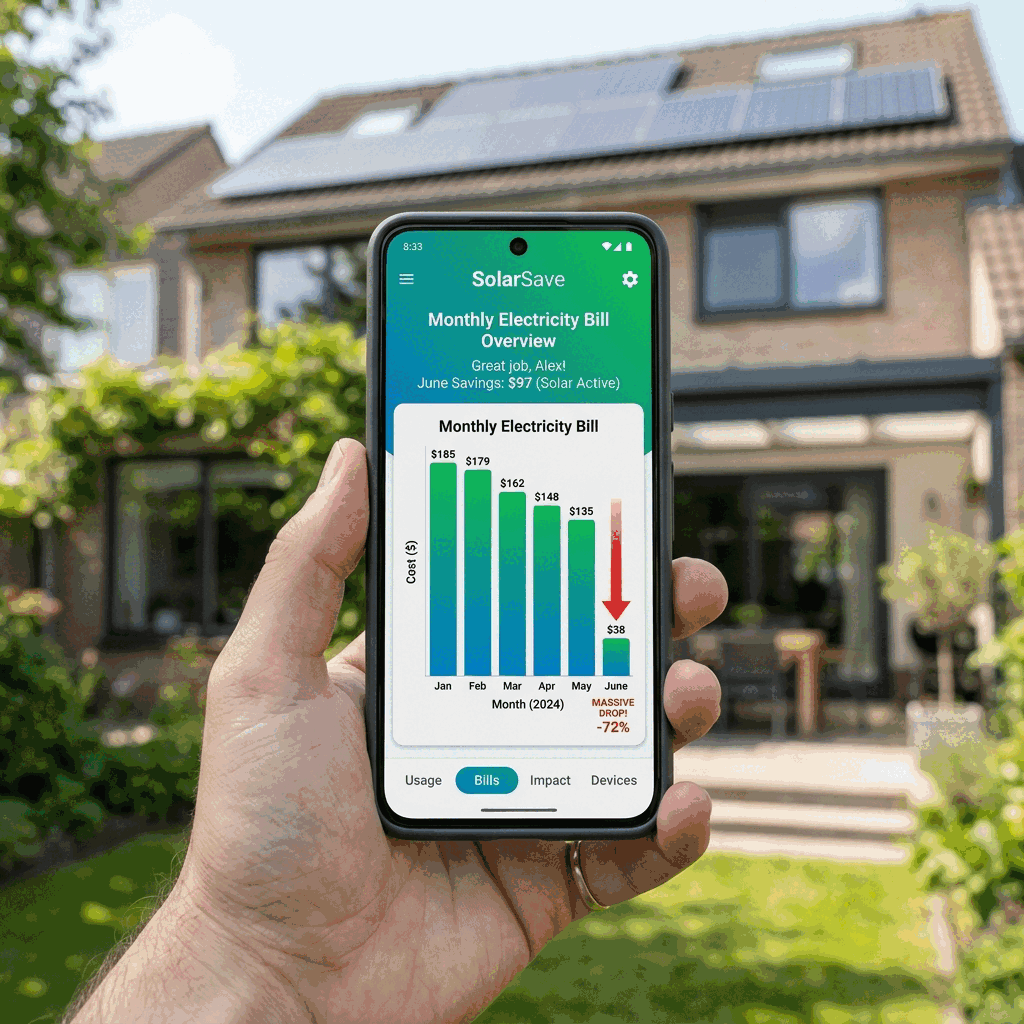
Figure 1: Tracking solar generation and bill reduction on a smartphone app, helping homeowners monitor payback speeds in real-time.
Regional Guide: Which System Fits Your Province?
- Metro Manila (Quezon City, Caloocan, Makati): Grid-Tie is highly practical if your grid is stable and you run multiple aircons during daytime office hours. However, Hybrid is preferred for high-value properties demanding zero flicker.
- Bulacan (SJDM, Malolos, Santa Maria): Hybrid is strongly recommended. Provincial electrical lines are prone to interruptions during storms, and backup power is highly valuable.
- Rizal (Antipolo, Cainta, Taytay): Hybrid is the standard. Hilly terrain and tree fall lead to frequent grid maintenance.
- Cavite & Laguna (Dasmariñas, Santa Rosa): Hybrid systems allow subdivisions with strict power terms to store their own energy and get backup protection during typhoon grid-downs.
Summary: Making the Choice
Choose Grid-Tie if:
- Your budget is limited to under ₱150,000.
- Your primary goal is offsetting high daytime aircon bills.
- Your neighborhood rarely or never experiences brownouts.
- You are comfortable using a Zero-Export limiter setup to avoid red tape.
Choose Hybrid if:
- You demand uninterrupted 24/7 power during typhoons and grid failures.
- You work from home and require stable internet/power.
- Your energy usage peaks at night (night shift, evening family hours).
- You want to store your own power rather than deal with Meralco Net Metering.
Unsure Which Package Fits Your Budget?
Use our interactive savings calculator to model both Grid-Tie and Hybrid packages based on your average monthly Meralco bill, or chat with our engineering team for an on-site assessment.