Living in the Philippines means dealing with typhoon season every year. For anyone investing ₱150,000 to ₱300,000+ in a home solar system, the biggest fear is structural failure: "Will a super typhoon rip my solar panels off my roof?"
The short answer is no, not if they are engineered and installed correctly. Properly installed solar panels are actually one of the most durable parts of a house, and can even act as a shield for your roof. Let's look at the science, materials, and local codes that guarantee typhoon survival.
1. Solar Panel Wind Load Ratings
Solar panels themselves are built to withstand harsh weather. High-quality monocrystalline panels are rated for a downward mechanical load of 5,400 Pascals (Pa) and an upward wind load of 2,400 Pa.
In simple terms, a 2,400 Pa rating means the glass and frame can withstand wind pressures equivalent to roughly 220 to 240 km/h hitting the panel face directly. But because solar panels are installed parallel to the angle of your roof, the wind flows *over* them, drastically reducing direct wind impact.
2. The Mounting System: The Real Backbone
When solar systems fail during a typhoon, it is almost never the panel that breaks. The failure occurs because of weak or poor mounting structures. To be typhoon-proof, solar mounting systems must use specialized, corrosion-resistant metals:
- Anodized Aluminum Rails: Aluminum does not rust, and anodizing provides a protective oxide layer that resists salty air in coastal provinces like Cavite and Metro Manila.
- Stainless Steel Clamps (304 or 316 Grade): The mid-clamps and end-clamps that pinch the panel frames to the aluminum rails must be high-grade stainless steel to prevent stress fracture.
- Hot-Dip Galvanized Brackets: Any structural steel brackets used to connect to concrete decks must be hot-dip galvanized to withstand tropical humidity without degrading.
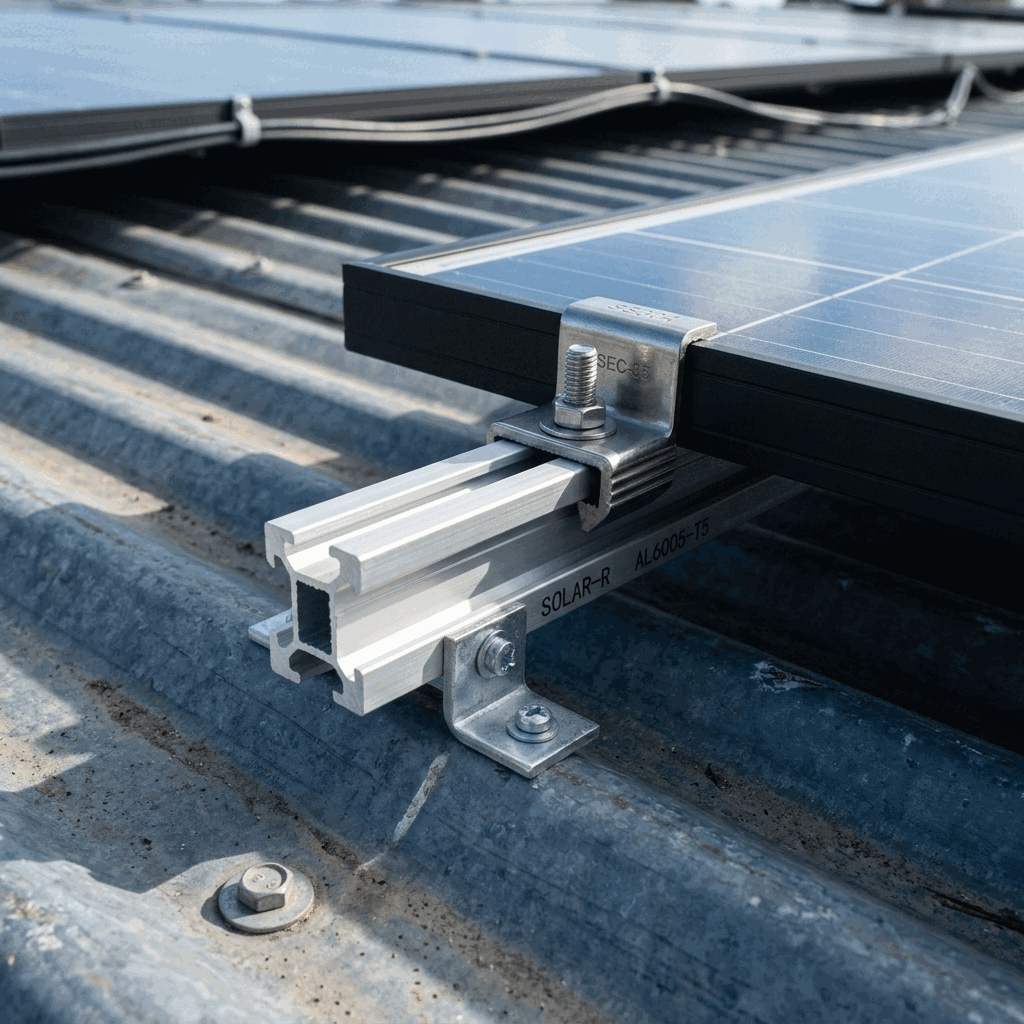
Figure 1: Close-up of a structural anodized aluminum mounting bracket and stainless steel clamp, securing a solar panel frame firmly against high wind loads.
3. Roof Attachment Techniques: Metal vs. Concrete
How the solar rack is anchored to your home is crucial. The methods differ depending on your roofing material:
Metal Sheet Roofing (G.I. Sheets)
Common in Bulacan and Cavite subdivisions. Installers use specialized L-Feet brackets that align with your roof's internal structural purlins (wooden or steel rafters). Self-tapping stainless steel screws penetrate the purlin, anchoring the system directly to the house framework.
Concrete Deck / Flat Roofs
Common in modern urban homes. Installers mount rails using chemical anchors or expansion bolts directly drilled into the concrete slab, or utilize heavy concrete ballast blocks that hold the array down via gravity, avoiding roof penetrations entirely.
4. Leak Prevention: Waterproofing the Penetrations
Because mounting on GI sheets requires screwing into your rafters, waterproofing is vital. Professional installers prevent roof leaks by using:
- EPDM Rubber Washers: Placed under the L-feet, these rubber seals squeeze tight around the screw hole, creating a waterproof barrier.
- Polyurethane Sealant (e.g. SikaFlex): A high-grade, UV-resistant polyurethane sealant is applied generously around every screw penetration. Unlike cheap silicone, polyurethane does not dry up or crack under the intense Philippine sun.
5. Compliance with the NSCP (National Structural Code)
According to the National Structural Code of the Philippines (NSCP), building structures must be engineered to withstand region-specific wind velocities:
- Zone 1 (Metro Manila, Rizal, Laguna, Cavite): Wind speed design rating of 250 km/h.
- Zone 2 (Bulacan, Central Luzon): Wind speed design rating of 270 km/h.
DUNYS Solar mounting structures are engineered to meet or exceed these NSCP wind speed zoning guidelines, ensuring that the aluminum rails, brackets, and bolts can hold down the panels even during Category 5 typhoons.
Post-Typhoon Checklist for Solar Owners
After a major storm, perform these simple visual checks (from the ground if possible, for safety):
- Check if any panels appear misaligned or shifted on the rails.
- Look for any flying debris (branches, sheet metal) that may have cracked the solar glass.
- Check the system monitoring app to ensure all panels are generating power normally.
- Inspect interior ceilings for any signs of water leakage near the mounting locations.
Invest in Storm-Hardened Solar Technology
At DUNYS Solar, we use only structural-grade anodized aluminum rails, stainless steel clamps, and premium polyurethane sealant rated for wind speeds up to 250 km/h. Contact us to evaluate your roof structure.